Agricultural Diesel Generator Sets for Farms & Livestock
Reliable standby or prime power for irrigation pumps, poultry houses, dairy operations, greenhouses, and grain storage—built for long runtime and harsh farm environments.
- Best for: irrigation pumps, livestock ventilation, milking systems, greenhouse climate control, grain drying & storage
- Configurations: ATS standby packages, silent canopy, extended fuel tank, trailer/container options
- Fast sizing & quote: share your load list + runtime + site conditions → get a recommendation in 24 hours
Farm & Agriculture Generator Guide: Typical Applications and Recommended Configurations
| Application | Typical loads | Recommended setup | Notes |
|---|---|---|---|
| Irrigation pumps | Motor loads (pumps), seasonal long runtime |
Prime-capable diesel genset + VFD/soft starter option + extended fuel tank
See irrigation pump generator sizing guide |
Consider motor starting surge; plan ventilation for high ambient temps |
| Poultry houses | Ventilation fans, lighting, feeding, water systems | Standby genset + ATS + silent canopy (if near housing) | Fast transfer protects animal welfare; noise may matter |
| Dairy farms | Milking systems, cooling, refrigeration, pumps | Standby/prime genset + ATS + stable voltage regulation | Prioritize reliable startup and steady power for sensitive equipment |
| Greenhouses | Ventilation, heating, circulation fans, controls | Standby genset + ATS + low-noise enclosure (as needed) | Long outages can damage crops—plan runtime and fuel logistics |
| Grain drying & storage | Dryers, conveyors, aeration fans | Prime/standby genset + robust cooling + dust-ready maintenance plan | Dusty environments require filter discipline and radiator cleaning |
| Remote farm standby | Whole-site backup, intermittent outages | Standby genset + ATS + remote monitoring | Remote alerts reduce downtime and service trips |
Notes: Final sizing depends on motor starting method (DOL/soft starter/VFD), duty cycle (standby vs prime), ambient temperature, altitude, dust level, enclosure type, and fuel supply logistics.
Explore by Farm Application


Poultry Farm Backup
Ventilation + ATS recommendations

Dairy Farm Standby
Stable power for milking & cooling

Greenhouse Backup Power
Climate control continuity

Grain Drying & Storage
Dust considerations +Runtime planning

Remote Farm Emergency Backup
Monitoring + Fast restoration
The agricultural and livestock sector presents distinct requirements, making it a unique area of application. To address this, we have developed a specialized range of generator sets tailored specifically for agriculture and livestock farming.
Which One Fits Your Runtime?
Standby vs Prime Power for Farms
Not sure which duty fits your farm? Send your load list and runtime—we’ll recommend standby vs prime and a suitable kW/kVA range.
Which One Fits Your Runtime?
Standby (Backup)
- Designed for outages and emergency backup
- Typically paired with ATS for automatic transfer
- Optimized for fast start, stable voltage, and reliability
- Best when runtime is occasional (hours/day during outages)
Prime (Long Runtime / Off-grid)
- Designed for longer daily runtime and steady loads
- Better cooling margin, service planning, and fuel logistics
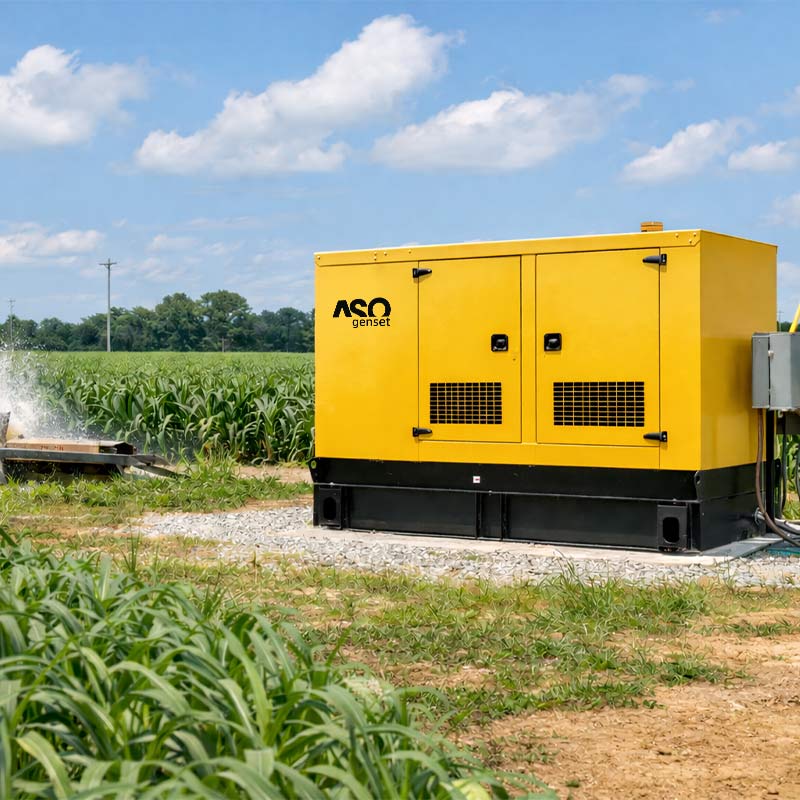
- Ideal for irrigation seasons, remote farms, and continuous operations
- Consider parallel units if loads fluctuate widely
What We Need to Size and Quote Your Farm Generator (Fast Checklist)
- Application (irrigation / poultry / dairy / greenhouse / grain / other)
- Load list (motors, fans, pumps, refrigeration, heaters)
- Motor starting method (DOL / soft starter / VFD)
- Voltage & phase (e.g., 400V 3-phase / 240V single-phase)
- Runtime (standby vs prime; hours/day)
- Site conditions (ambient temperature, altitude, dust, noise limits)
- Delivery destination & preferred lead time
Example: Irrigation pumps 2×15 kW + lighting, prime 10h/day, 40°C, 300m altitude, 400V 3P, need extended tank.
FEATURES
Recommended Generator Configurations for Agriculture
Energy needs in the agricultural industry
The energy demands in the agricultural sector vary widely, leading to a diverse range of power generators and their capabilities. We focus on addressing these requirements through the following tasks:
Implementation of irrigation systems
Electric pumps for irrigating large areas of land that lack direct access to the power grid.
Tool use
Use of tools requiring an electrical power source.
Electric power from the tractor
Harnessing electricity from the tractor as the sole available energy source.
Emergency use of generators
Using electricity generators as an emergency backup during mains power outages, particularly on farms and livestock operations.
Agricultural Generator FAQ
Get a Farm Generator Recommendation & Quote
Farm Power Guides
Practical guides for powering every type of farm operation:
Frequently asked questions
Written and reviewed by Smith Parkson, Power Systems Engineer at ASO Genset · Last updated July 2026.