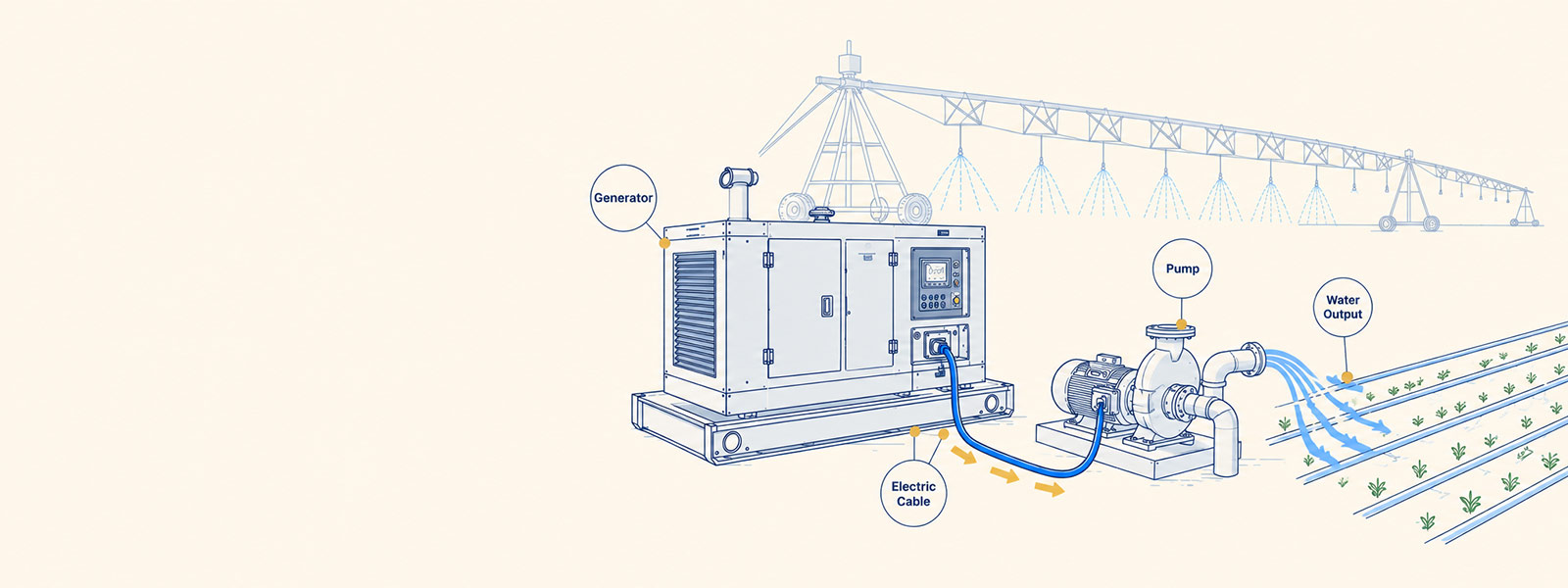
Diesel generator powering an irrigation pump with a center pivot irrigating crops in the background
ASO Genset · Farm Power

Irrigation Pump Generators: Sizing & Selection

Match the generator to the pump — running kW, starting surge, and field duty — for wells, sprinklers and center pivots.
3–6×
starting surge of a DOL-started pump
2.5–3×
genset sizing rule for DOL starts
~1.5×
with a soft starter or VFD
Quick answer: To run an irrigation pump from a generator, size for the pump’s running kW plus its starting surge — a centrifugal or submersible pump started direct-on-line (DOL) draws 3–6× its rated current for a few seconds. Rule of thumb: pick a generator of about 2.5–3× the pump’s rated kW for DOL starts, or ~1.5× with a soft starter or VFD. For remote center pivots, dedicated diesel power units are the standard choice.
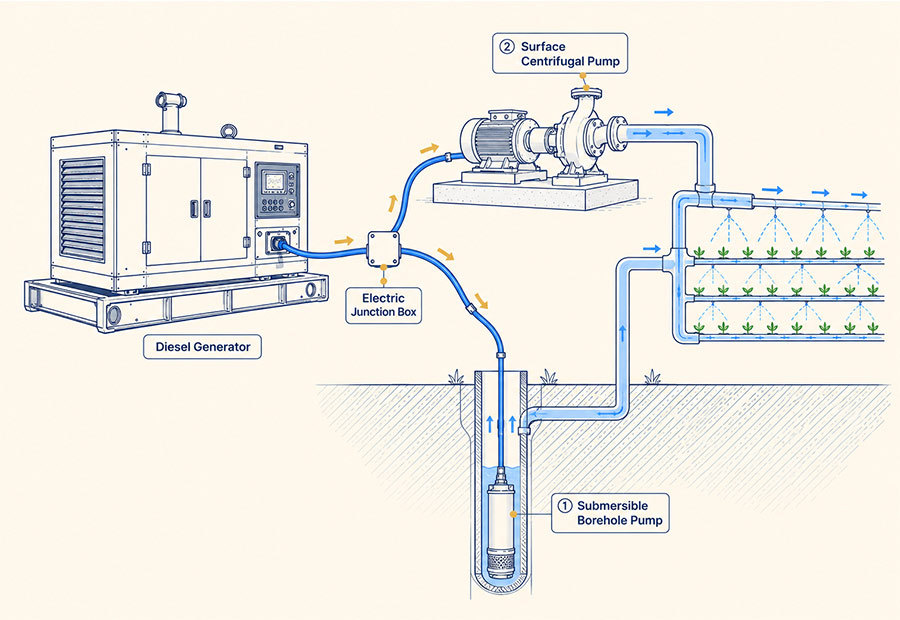
Diagram of a diesel generator powering a submersible borehole pump and a surface centrifugal pump for field irrigation
One genset, two common pump set-ups: submersible borehole and surface centrifugal.
Basics

01Can a generator run an irrigation pump?

Yes — and on remote fields it is often the only option. There are two set-ups: an electric pump powered by a generator (submersible borehole pumps, surface centrifugal pumps, sprinkler and drip systems), or an engine-driven pump that moves water mechanically without electricity. This guide covers the first: matching a diesel generator to electric irrigation pumps and pivot systems.

The critical detail is motor starting. Pumps are induction motors: at start they draw far more than their nameplate rating. Get the surge wrong and the generator trips, stalls, or slowly cooks the pump motor with low voltage.
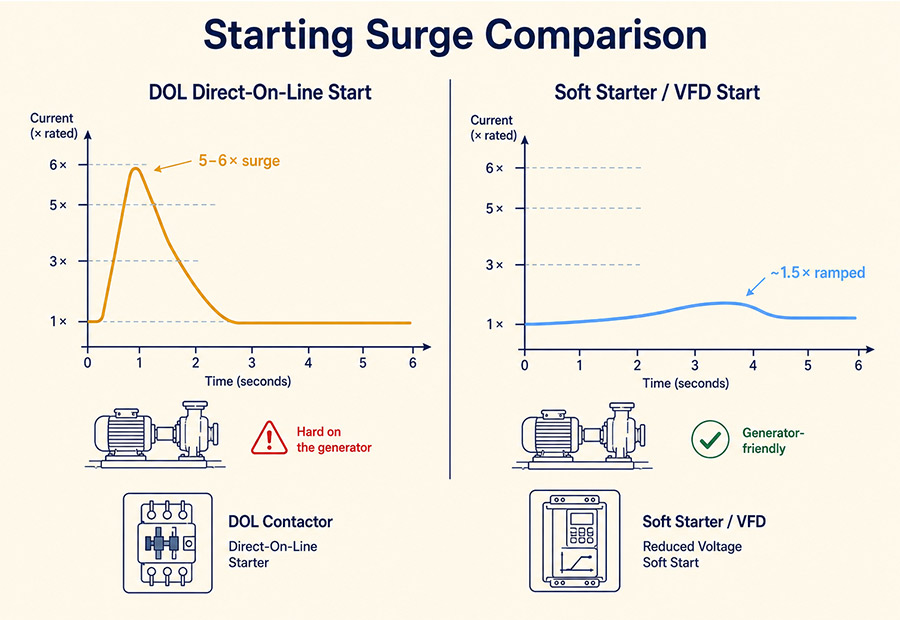
Starting surge comparison: DOL direct-on-line start draws 5-6x rated current vs about 1.5x with a soft starter or VFD
DOL starts hit 5–6× rated current; a soft starter ramps it to ~1.5×.
Sizing

02Generator sizing for irrigation pumps

Start from the pump’s rated kW (1 HP ≈ 0.75 kW), then apply the starting method. Direct-on-line (DOL) is simple but demands the biggest generator; a soft starter or VFD cuts the surge and lets you run a much smaller set.

Multiple pumps? Stagger the starts — size for the largest motor’s surge plus the running load of the rest. High-ambient sites should also allow for temperature derating.

Typical pairings (pf 0.8, one pump starting at a time) — indicative figures; share your motor data and we’ll confirm the kVA:

Pump ratingGenerator @ DOL startWith soft starter / VFD
5.5 kW (7.5 HP)~15 kVA~9 kVA
11 kW (15 HP)~30 kVA~15–20 kVA
18.5 kW (25 HP)~45 kVA~25 kVA
30 kW (40 HP)~75 kVA~40 kVA
45 kW (60 HP)~110 kVA~60 kVA
Remote fields

03Center pivots & remote irrigation power

Center pivots and remote boreholes usually sit far from the grid, so they run on dedicated diesel power units — skid- or trailer-mounted generators with large fuel tanks, weather canopies and simple auto-start. What matters in the field:

  • Fuel autonomy: a tank sized for at least a full irrigation shift (12–24 h) without refuelling.
  • Dust & heat: tropical-rated radiators and good air filtration — chaff and dust clog cores fast in season.
  • Voltage stability (AVR): pivots combine drive motors and controls; poor regulation causes nuisance faults.
  • Mobility: trailer mounting lets one set serve several pump points across the season.
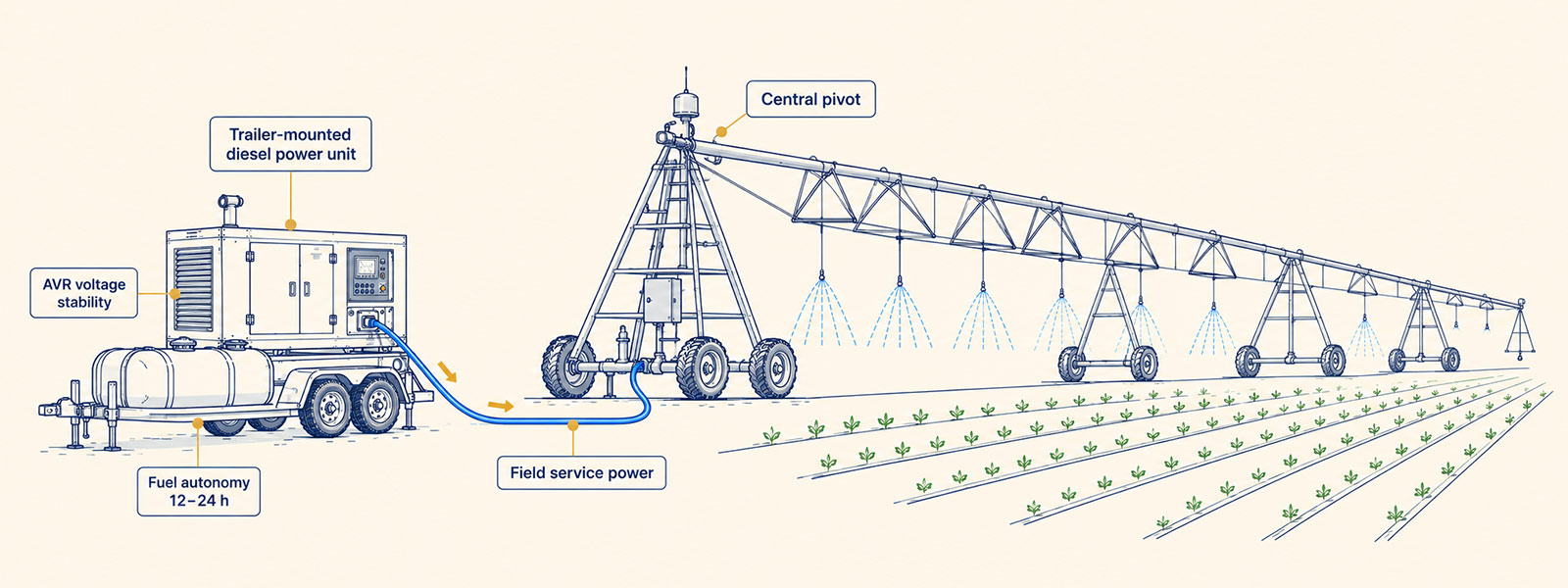
Trailer-mounted diesel power unit with fuel tank powering a center pivot irrigation system in a field
A trailer-mounted diesel power unit feeding a center pivot — fuel autonomy and AVR stability are the two things that matter most.
PTO generator driven by a tractor compared with a dedicated diesel genset with integrated fuel tank for irrigation
Occasional pumping favours PTO; season-long duty favours a dedicated genset.
Which set-up

04PTO generator vs dedicated diesel genset

A PTO generator runs off your tractor’s power take-off shaft — cheap to buy and fine for occasional pumping. A dedicated diesel genset costs more upfront but frees the tractor, runs continuously all season, and can back up the rest of the farm too.

FactorPTO generator (tractor-driven)Dedicated diesel genset
Upfront costLow (uses your tractor)Higher (dedicated unit)
Ties up a tractorYes — tractor is parked at the pumpNo — tractor stays free for field work
Continuous dutyLimited; tractor engine hours add up fastDesigned for long runs, 24/7 in season
Powers other loadsPump only, where the tractor isPump + farm buildings via changeover
Best forOccasional / emergency pumpingSeason-long irrigation & multi-use
Fuel

05Fuel & runtime for all-day irrigation

Irrigation runs long hours, so fuel is the real operating cost. A diesel genset burns roughly 0.2–0.25 litres per kWh; a 30 kVA set at 75% load uses about 5–6 L/hr, or 60–75 litres over a 12-hour shift — size the day tank accordingly. Run pumps at 50–80% generator load for the best efficiency and engine life.

Full figures by kVA and load: see our diesel generator fuel consumption chart · saving tips in farm fuel savings.

Sizing a generator for irrigation or a remote pivot?

ASO supplies diesel gensets 8–3000 kVA with tropical-rated cooling and large fuel tanks — delivered worldwide.

Get a Sizing Recommendation
FAQ

06Frequently asked questions

What size generator do I need to run a water pump?Size for the pump's running kW plus its starting surge. A pump started direct-on-line (DOL) can draw 3–6 times its rated current for a few seconds, so choose a generator around 2.5–3 times the pump's rated kW for DOL starts, or about 1.5 times with a soft starter or VFD. Example: an 11 kW (15 HP) pump typically needs a ~30 kVA generator at DOL, or ~15–20 kVA with a soft starter.
How much is an irrigation generator?It depends on size and duty. Small portable sets for household pumps start from a few hundred dollars, while dedicated diesel irrigation power units for pivots and large pumps typically run from about $8,000 to $25,000 or more. Continuous field duty favours a diesel genset with a large fuel tank.
How big of a generator do I need to run a water well?Take the well pump's rated kW (1 HP ≈ 0.75 kW) and multiply by roughly 3 for a DOL start. A 2 HP (1.5 kW) submersible well pump usually runs safely from a ~5 kVA generator; a 5 HP (3.7 kW) pump needs about 10–12 kVA.
Can you run a water pump with a generator?Yes. Make sure the generator covers the starting surge, has a stable voltage regulator (AVR), and is properly earthed. Undersized generators trip or stall at pump start-up, and repeated brown-outs shorten pump motor life.

Written and reviewed by Smith Parkson, Power Systems Engineer at ASO Genset · Last updated July 2026.