Generator Cooling System: How It Works & Types
01How a generator cooling system works
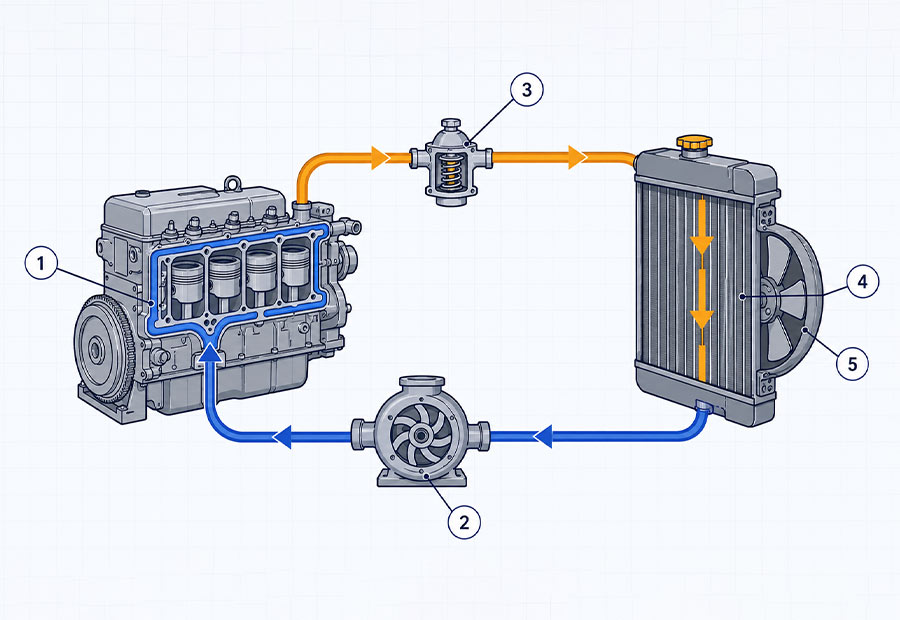
Combustion produces heat; the cooling system carries it away. In an air-cooled generator a fan blows air directly over the engine's fins. In a liquid-cooled generator a water pump circulates coolant through the engine jacket, a thermostat regulates temperature, and a radiator with a fan releases the heat — then the coolant returns to the engine and the cycle repeats.
02Types of generator cooling systems
Air-cooled
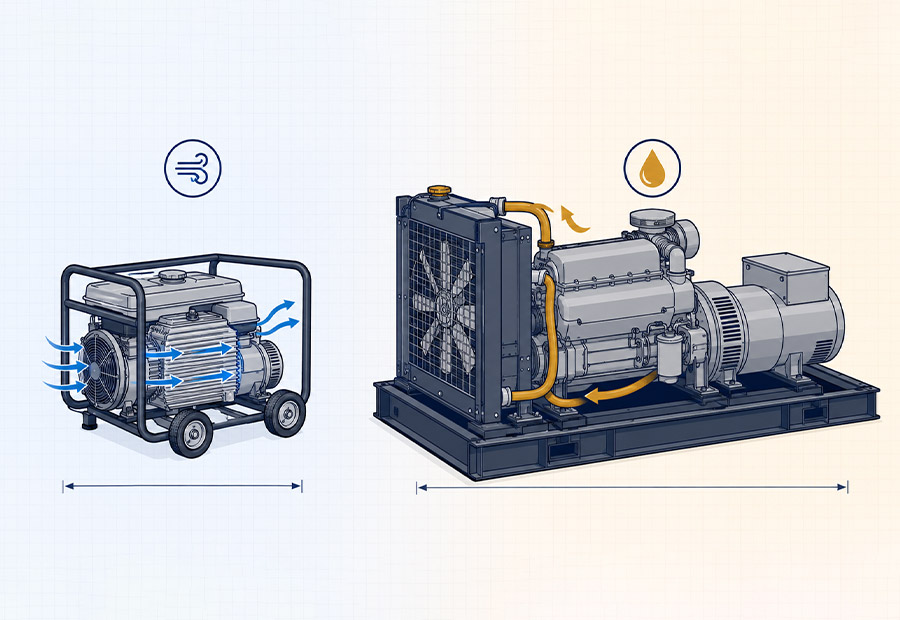
A fan blows air directly over the engine. Simple, compact and low-cost — used on small and portable generators, typically below ~20–30 kW.
Liquid-cooled
Coolant, a radiator and a water pump (jacket-water cooling). It handles continuous high loads and is standard on commercial diesel gensets. Includes closed-loop (jacket water) and, on marine sets, open-loop (raw water) cooling.
03Key components of a liquid-cooled system
The radiator sheds heat, the cooling fan moves air across it, the water pump circulates coolant, the thermostat regulates temperature, and coolant (a 50/50 antifreeze-and-water mix) carries the heat. Hoses and a pressure cap complete the loop.
The radiator is the part that most often needs attention — see our full generator radiator maintenance & cleaning guide.

04Air-cooled vs liquid-cooled (summary)
Short version — air-cooled is cheaper and simpler for small loads; liquid-cooled is quieter and built for continuous commercial use:
For the full cost, noise, lifespan & TCO comparison, see Air-Cooled vs Liquid-Cooled Generator.
05Coolant & cooling maintenance basics
Use the correct coolant (typically a 50/50 antifreeze-and-water mix), keep it topped up and fresh, keep the radiator core clean, and inspect hoses, the pressure cap and the fan belt. Good cooling maintenance is the simplest way to prevent overheating.
Full prevention & troubleshooting: Generator Overheating: Causes, Fixes & Prevention.
06Ventilation & high-temperature derating
Indoor and enclosed generators need adequate ventilation — enough intake and exhaust airflow — so the cooling system can actually reject heat. In hot or high-altitude sites, output may need to be derated, because hotter or thinner air carries away less heat; high-ambient (“tropical”) radiator cores are specified for such sites.
Generator cooling topics
This guide is the hub — dive into any sub-topic:
07Frequently asked questions
Written and reviewed by Smith Parkson, Power Systems Engineer at ASO Genset · Last updated July 2026.